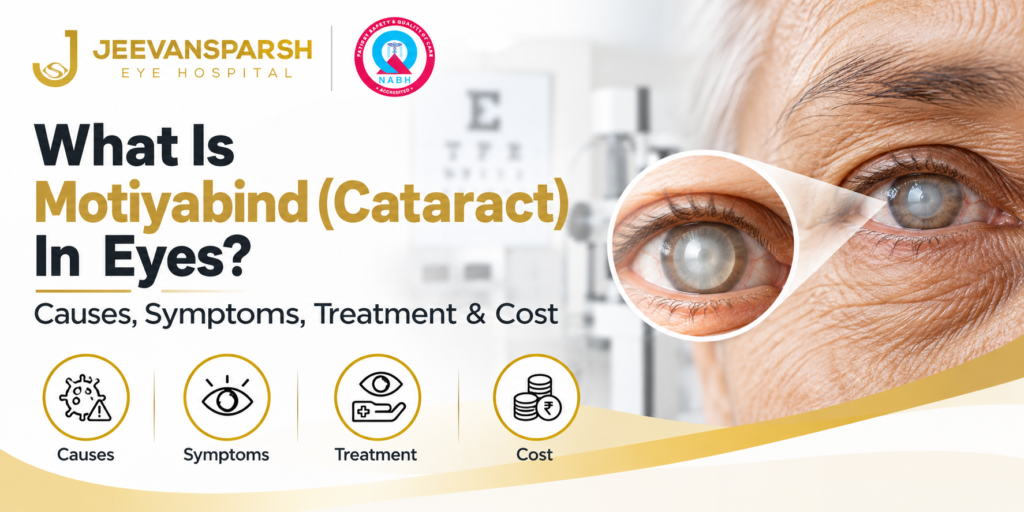
What Is Motiyabind (Cataract) In Eyes? Causes, Symptoms, Treatment & Cost
Have you or someone in your family started seeing things as if through a foggy window? Do you keep needing new glasses every few months? It could be motiyabind, which is called cataract in English. It is one of the most common causes of vision loss in India. The good news is that motiyabind has a proven treatment, and modern cataract surgery is safe, quick and nearly painless.
This guide covers what motiyabind is, its symptoms, types, diagnosis, treatment and operation cost.
What Is Motiyabind (Cataract)?
Inside your eye is a clear, transparent natural lens. It works like a camera lens, focusing light onto the retina so you can see sharply.
When the proteins in this lens clump together, the lens turns cloudy or milky. This clouding is called motiyabind (cataract). It is like trying to look through a frosted or dirty window: everything looks hazy and dull.
Key facts:
- Motiyabind affects the lens inside the eye, not the outer surface.
- It usually develops slowly and can affect one or both eyes.
- It does not spread from one person to another, and it does not spread from one eye to the other.
- Eye exercises, drops and home remedies cannot cure it.
Motiya in Eyes: Causes
The biggest cause is age, with cataracts commonly appearing after 50 to 60. But it is not only an old-age problem. These factors also play a role:
- Diabetes: High blood sugar speeds up cataract formation. Diabetic patients need extra care before and after surgery, as explained in our complete guide to caring for cataract patients.
- UV rays from sunlight: Spending long hours outdoors without sunglasses.
- Smoking and alcohol: Both raise the risk.
- Steroid medicines: Long-term use of steroid tablets, drops or inhalers.
- Eye injury or previous eye surgery.
- Other eye conditions: Such as uveitis or very high myopia (high minus power).
- High blood pressure and obesity.
- Family history.
- Birth-related causes (congenital): Infections during pregnancy, such as rubella, or genetic reasons. Children with this condition need specialist care from a pediatric ophthalmologist.
Symptoms of Motiyabind (Cataract)
Early symptoms are mild, and many people dismiss them as weak eyesight. Watch for these signs:
- Blurry, hazy or cloudy vision
- Difficulty driving at night (this can also be a sign of night blindness, so get it checked)
- Glare, or halos around bulbs and headlights
- Faded or yellowish colors
- Double vision in one eye
- Frequent changes in glasses prescription
- Needing more light to read
- In some people, near vision suddenly seems better. This is called “second sight,” and it is a temporary effect that signals a developing cataract.
Pain, redness and watery eyes are not typical cataract symptoms. If you have them, another problem may be involved, so see a doctor promptly.
When Should You See a Doctor?
- Daily activities like reading, watching TV or driving are becoming difficult
- There is a big difference between the vision of your two eyes
- You have sudden vision loss, severe eye pain or redness (this is an emergency)
If any of these apply to you, you can book an appointment with an eye specialist.
Types of Cataract (Motiyabind)
| Type | Where it forms | Key point |
|---|---|---|
| Nuclear Cataract | Center of the lens | Most common, linked to ageing. The lens may turn yellow or brown |
| Cortical Cataract | Edges of the lens | White, wedge-shaped streaks like wheel spokes, causes more glare |
| Posterior Subcapsular (PSC) | Back of the lens | Progresses quickly, common with steroid use and diabetes. Affects reading and bright-light vision |
| Congenital Cataract | Present at birth or in childhood | Early treatment is vital for a child’s visual development |
| Traumatic Cataract | After an eye injury | Can appear soon after injury or years later |
| Secondary Cataract | Due to other diseases or medicines | Caused by diabetes, uveitis or steroids |
You may also hear of black motiyabind. This is a very advanced, hard cataract in which the lens turns dark brown or nearly black. Operating before it reaches this stage is better, because very hard cataracts make surgery more difficult.
How Is Motiyabind Diagnosed?
Diagnosis is simple and painless. An eye specialist (ophthalmologist) may do these tests:
- Visual acuity test: Reading an eye chart to measure how well you see.
- Slit-lamp examination: A special microscope to examine the lens closely.
- Dilated eye exam: Drops widen the pupil so the lens and retina can be examined properly.
- Tonometry: Measures eye pressure to check for glaucoma.
- Biometry/Keratometry: Measures the eye so the right power of artificial lens can be chosen for surgery.
People with diabetes should also have a retina check, since diabetic retinopathy can affect vision alongside cataract.
Treatment for Cataracts (Motiyabind)
Can medicines or eye drops cure motiyabind? No. At present, the only reliable way to remove a cataract is surgery.
In the early stage, when vision problems are mild, a doctor may suggest:
- A new glasses prescription
- Better lighting and anti-glare glasses
- Blood sugar control and regular follow-ups
When should you get operated? The old belief was to “wait until the cataract ripens.” That is outdated. When the cataract starts interfering with daily life, you can discuss surgery with your doctor. Waiting too long makes the cataract harder, the surgery more complex and the risk of complications higher.
How Is the Surgery Done?
In cataract surgery, the cloudy lens is removed and replaced with a clear artificial lens called an IOL (intraocular lens).
- Phacoemulsification (Phaco): Ultrasound breaks the cataract into tiny pieces through a small cut, and a foldable lens is implanted. This is the most popular method.
- MICS (Micro-Incision Cataract Surgery): An even smaller incision.
- SICS (Small Incision Cataract Surgery): Suitable for hard cataracts and generally more economical.
- Femtosecond laser (FLACS): A laser performs some of the steps. It is not necessarily better for every patient. Read more in blade-free vs traditional cataract surgery.
Surgery usually takes 15 to 30 minutes, is done under numbing drops or a mild injection, and most people go home the same day.
Lens (IOL) Options
- Monofocal: Clear vision at one distance (usually far). You may still need glasses for reading.
- Multifocal/Trifocal/EDOF: Clear vision at multiple distances, reducing dependence on glasses.
- Toric: Corrects astigmatism (cylindrical power).
Aftercare
- Use prescribed eye drops on time
- Keep water and dirt out of the eye, and avoid rubbing it, for as long as your doctor advises
- Wear sunglasses outdoors
- Avoid heavy lifting and straining
- Attend all follow-up visits
Most people notice better vision within days, and full recovery takes a few weeks. For a detailed timeline, see our guides on eye surgery recovery and recovery after cataract and LASIK surgery.
Motiyabind Operation Cost in India
The cost depends on your city, hospital, surgeon, type of surgery and especially the type of lens. These are approximate per-eye ranges from published hospital sources:
| Surgery Type | Approx. Cost (per eye) |
|---|---|
| SICS | ₹15,000 – ₹35,000 |
| Phaco | ₹15,000 – ₹60,000 |
| MICS | ₹45,000 – ₹1,50,000 |
| Femtosecond laser (FLACS) | ₹70,000 – ₹2,00,000 |
By lens type, phaco with a multifocal lens is listed at about ₹45,000 to ₹85,000, and with an EDOF lens at about ₹55,000 to ₹1,00,000.
If you are looking for an affordable option, see low cost cataract surgery in Pune.
Insurance and government schemes:
- Most health insurance plans in India cover only a standard monofocal lens. The extra cost of a premium lens is paid by the patient. Learn about cashless insurance and claim support before your surgery. joinditto
- Ayushman Bharat (PM-JAY) lists cataract surgery in its health benefit packages. Check eligibility and empanelled hospitals at your nearest Ayushman centre. centreforsight
These figures are estimates only. Ask 2 to 3 hospitals for a written estimate before deciding.
Common Myths About Motiyabind
- “Wait until it ripens.” False. You can get operated once daily life is affected.
- “Laser or medicine can dissolve it.” False. A cataract cannot be dissolved with drops or a laser beam.
- “The eye is taken out during surgery.” False. The eye stays in place.
- “Mobile and TV cause cataracts.” There is no firm proof, but long screen time can strain your eyes, so take regular breaks. See our guide on digital eye strain.
- “The cataract comes back after surgery.” It does not. In some people the membrane behind the new lens becomes cloudy (called PCO), and a quick laser procedure fixes it.
How Can You Reduce the Risk?
You cannot fully prevent cataracts, but you can slow them down:
- Wear UV-protective sunglasses
- Keep blood sugar and blood pressure under control
- Quit smoking and limit alcohol
- Do not take steroids without medical advice
- Get an eye check-up every year after age 40
- Eat plenty of green vegetables and fruit
FAQs
1. What is motiyabind called in English?
Cataract.
2. Is cataract surgery painful?
No. Numbing makes it painless, though you may feel slight pressure.
3. Does motiyabind affect both eyes?
It often does, although one eye may be worse or develop earlier than the other.
4. Can motiyabind go away without surgery?
No. Medicines, drops and home remedies do not cure it.
5. What happens if cataract is left untreated?
Vision keeps declining and can eventually lead to blindness, which is treatable with surgery.
6. How long does recovery take?
Most people see better within a few days, and full recovery takes a few weeks.
7. Can children get cataracts?
Yes. Some are born with them or develop them in childhood. Early treatment is important for the child’s vision development.
Conclusion
Motiyabind (cataract) is clouding of the eye’s natural lens caused by age, diabetes, UV exposure and other factors. Because it is painless, people often ignore it. With timely diagnosis and surgery, clear vision can be restored.
If you notice any of the symptoms above, visit the best eye hospital in Pune or book your appointment today. You can also read about our team on the About Us page.