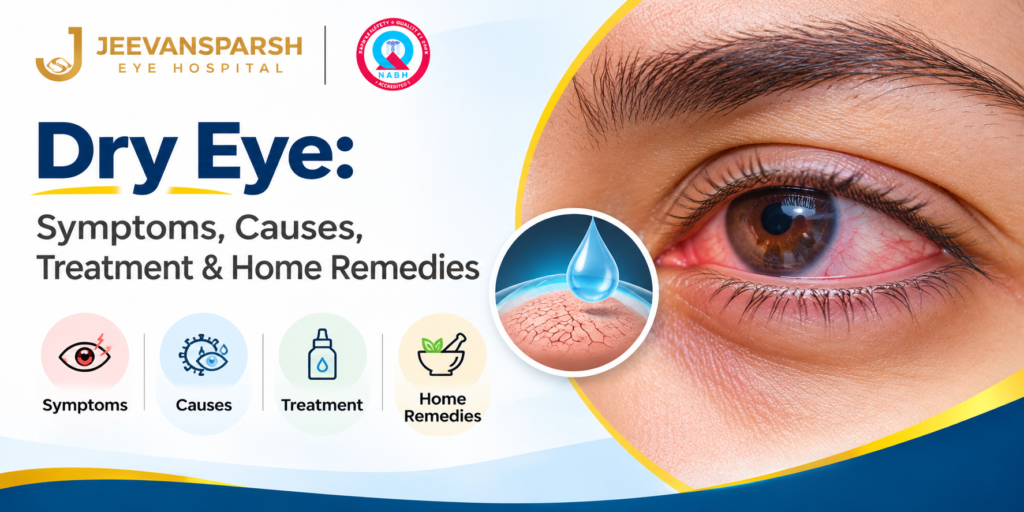
Dry Eye: Symptoms, Causes, Treatment & Home Remedies
Quick answer
Dry eye is a condition in which your eyes do not make enough tears, or the tears dry up too quickly, so the surface of the eye becomes irritated and sometimes blurry. Common dry eye symptoms are burning, grittiness, redness, watering and tired eyes. Dry eye is usually a long-term condition that can be controlled with lubricating eye drops, eyelid care, lifestyle changes and, in stubborn cases, in-clinic treatment. Severe untreated dry eye can damage the cornea, but it rarely causes complete blindness.
Key points at a glance
Do your eyes burn by evening, feel gritty when you blink, or water for no clear reason? You may have dry eye. It is one of the most searched eye problems today because long screen hours, air-conditioning and pollution affect almost everyone. This guide explains dry eye in simple words: what it is, the symptoms, the causes, the right eye drops for dry eyes, safe home remedies, whether dry eye can be cured permanently and whether it can ever lead to blindness.
1What is dry eye?
Dry eye (also called dry eye disease or dry eye syndrome) happens when the tear film that covers your eye is too little, unstable or poor in quality. Every blink spreads a thin layer of tears over the cornea. This layer keeps the eye comfortable, washes away dust and gives you sharp vision. When it breaks down, the eye surface becomes dry and inflamed.
The tear film has three layers, and a problem in any one of them can cause dry eye:
| Layer | Made by | What it does |
|---|---|---|
| Oily (lipid) layer | Meibomian glands in the eyelids | Stops the watery layer from evaporating too fast. |
| Watery (aqueous) layer | Lacrimal (tear) glands | Moistens the eye, washes out dust and carries nutrients. |
| Mucus (mucin) layer | Goblet cells on the eye surface | Helps tears spread evenly and stick to the eye. |
Two main types of dry eye
Many people have a mix of both types, which is why a proper eye examination matters before choosing a treatment.
2Dry eye symptoms
Dry eye symptoms usually affect both eyes and tend to get worse in the evening, in air-conditioned rooms, in wind and after long screen use. Here is how they usually feel:
🚨 See an eye doctor the same day if you notice:
- Severe eye pain or a feeling that something is stuck that does not go away
- Sudden drop in vision or increasing blur
- Marked redness with light sensitivity or discharge
- A red, painful eye while wearing contact lenses
Dry eye symptoms can look like other problems such as allergy or infection, and staring at screens makes all of them worse. Our guide on digital eye strain explains how the two are connected.
3Eye dryness causes
Eye dryness has many possible causes, and often more than one is present at the same time. Finding the main cause is the key to long-lasting relief.
If you take regular medicines or have a long-term condition, do not stop them on your own. Speak to your doctor, who can adjust treatment safely. Some patients using glaucoma drops also develop dryness, and you can read more about glaucoma care in Pune if this applies to you.
4Eyelid dryness: why it happens and what helps
Dry eye and eyelid dryness often go together. If the skin of your eyelids is dry, flaky, itchy or red, the cause is usually one of the following:
- Blepharitis: inflammation of the eyelid edges that causes crusts, itching and burning.
- Meibomian gland dysfunction: blocked oil glands that cause dry eye and tender, swollen lids.
- Eczema or contact dermatitis: a reaction to cosmetics, creams, face wash, hair dye or even eye drops.
- Demodex mites: tiny mites on the lashes that can inflame the lid margins, more common with age.
- Allergy: dust, pollen and pets can make lids itchy and swollen.
What helps eyelid dryness
- ✓Apply a warm (not hot) clean compress over closed lids for 5 to 10 minutes once or twice a day.
- ✓Gently massage the lid edges after the compress to help oil flow from the glands.
- ✓Clean the lash line with a lid-cleansing wipe or the solution your doctor suggests.
- ✓Remove eye makeup fully every night and replace old mascara and eyeliner every three months.
- ✓Do not rub your eyes or use steroid creams around the eyes without medical advice.
If eyelid dryness lasts more than two weeks, keeps coming back or is painful, it needs an eye examination. Treating the lids is often the fastest way to improve dry eye itself.
5Eye drops for dry eyes (dry eye drops)
Eye drops for dry eyes are the first-line treatment for most people. Not all dry eyes drops are the same, though. The right drop depends on the type and severity of your dry eye, so it helps to know the main choices:
| Type of drop | Best for | Good to know |
|---|---|---|
| Lubricating drops (artificial tears) | Mild or occasional dry eye | Easy to find; use as advised on the pack or by your doctor. |
| Preservative-free single-use vials | Frequent use, sensitive eyes, contact lens wearers | Gentler on the eye surface; each vial is used once and then discarded. |
| Lipid-based or emulsion drops | Evaporative dry eye with MGD | Add an oily layer to slow evaporation; may blur vision briefly. |
| Gels and ointments | Night-time and severe dryness | Longer-lasting but blur vision, so best at bedtime. |
| Prescription anti-inflammatory drops | Moderate to severe dry eye with inflammation | Work over weeks and are used only on a doctor’s advice. |
| Autologous serum drops | Severe dry eye not helped by other drops | Made from the patient’s own blood in a specialised setting. |
How to use dry eye drops correctly
- ✓Wash your hands, tilt your head back and pull the lower lid down to make a small pocket.
- ✓Do not touch the bottle tip to your eye or lashes, as this contaminates the bottle.
- ✓Wait about 5 minutes between two different drops, and apply gels or ointments last.
- ✓Close your eyes gently for a minute after the drop. Do not blink hard or rub.
- ✓Check the discard date after opening. Most multi-dose bottles should be discarded within a month unless the label says otherwise.
- ✓Remove contact lenses before using drops unless your doctor or the label says they are safe to use with lenses.
⚠ Caution: Avoid drops sold to “whiten” or “remove redness”. They shrink blood vessels and can make dry eye worse with regular use. Never use steroid drops or old leftover drops without an eye doctor’s advice.
If you wear contact lenses, ask whether your dry eye drops are compatible with them. Our guide on LASIK vs contact lenses explains the trade-offs when lenses become uncomfortable.
6How to treat dry eyes at home (dry eyes remedy)
Simple, safe habits are the best dry eyes remedy at home, and they work best together with the right drops:
- 1Warm compress: hold a clean, warm cloth on closed eyelids for 5 to 10 minutes to melt the thickened oil in the glands.
- 2Blink fully and often: a slow, complete blink every few seconds spreads tears evenly. Do this on purpose when you are on screens.
- 3Follow the 20-20-20 rule: every 20 minutes, look at something 20 feet away for 20 seconds.
- 4Adjust your surroundings: keep AC vents and fans from blowing on your face, use a humidifier in dry rooms and keep your screen slightly below eye level.
- 5Drink enough water: dehydration can make dryness worse, so sip water through the day.
- 6Eat for eye health: leafy greens, fruit, nuts, seeds and omega-3 sources such as fish or flaxseed support general eye health. Evidence for omega-3 capsules is mixed, so ask your doctor before starting any supplement.
- 7Protect your eyes outdoors: wraparound sunglasses reduce wind, dust and sun exposure.
- 8Rest and avoid smoke: sleep well, avoid smoking and stay away from smoky rooms.
⚠ Avoid these “home remedies”: Do not put rose water, honey, milk, tea bags, ghee or any home-made liquid in your eyes. These are not sterile and can cause serious infections. Warm compresses and sterile eye drops are the safe options.
7How to cure dry eyes permanently
Many people search for how to cure dry eyes, and especially how to cure dry eyes permanently, so here is the honest answer. For most people, dry eye is a chronic condition that is controlled, not cured once and for all, much like dry skin. The good news is that with the right plan, symptoms can stay under control for years, and some causes can be fixed completely, such as a medicine side effect, blepharitis or a vitamin deficiency.
Doctors usually treat dry eye step by step, moving ahead only if the earlier step is not enough:
- 1Drops and lifestyle: lubricating drops, screen breaks, better air quality, warm compresses and lid hygiene.
- 2Treat the root cause: manage MGD or blepharitis, review dry-eye-causing medicines and control conditions such as diabetes or thyroid disease.
- 3Prescription medicines: anti-inflammatory drops, short courses of other medicines and oral supplements when your doctor advises.
- 4Punctal plugs: tiny plugs placed in the tear drainage openings to keep your own tears on the eye longer.
- 5Advanced options: in-clinic eyelid treatments for blocked glands, autologous serum drops or special scleral lenses for severe dry eye.
Your ophthalmologist will advise which of these suit your eyes. If you plan vision correction surgery, dry eye should be treated first. Read about LASIK eye surgery in Pune and who qualifies.
8Can dry eyes cause blindness?
This is one of the most common worries, and the short answer is: rarely. Mild and moderate dry eye is uncomfortable but does not cause blindness. The risk comes from severe, long-standing dry eye that is never treated, because the unprotected cornea can then be damaged.
- Scratches and erosions on the corneal surface that heal poorly.
- Corneal infection and ulcers, which can leave a permanent scar.
- Scarring and thinning of the cornea that reduces vision.
- Higher risk in patients with Sjögren’s syndrome, severe lid problems, chemical injuries or prolonged contact lens misuse.
Complete blindness from dry eye is very uncommon, and early treatment prevents almost all serious complications. If you have pain, light sensitivity or falling vision, do not wait. People with cataract or other eye conditions should also keep dry eye controlled; learn more about cataract and how treatment is planned.
9How to avoid dry eyes
Prevention is easier than treatment. These everyday habits lower your chance of getting dry eye, or of it getting worse:
- ✓Take regular screen breaks and blink fully. Increase text size and reduce screen glare.
- ✓Do not sit directly in front of an AC vent, fan or car air vent.
- ✓Use a humidifier in dry rooms, and keep rooms clean and dust-free.
- ✓Wear sunglasses or protective glasses in wind, dust and bright sun.
- ✓Clean your eyelids regularly if you are prone to blepharitis or MGD.
- ✓Follow contact lens hygiene strictly, replace lenses on schedule and give your eyes lens-free time.
- ✓Remove eye makeup every night and avoid applying it on the inner lid margin.
- ✓Drink enough water and eat a balanced diet rich in leafy vegetables, fruit and healthy fats.
- ✓Avoid smoking and smoky environments.
- ✓Get a regular eye check-up, especially if you are over 40, have diabetes or take long-term medicines.
Children who spend long hours on tablets and phones can also develop dry eye symptoms. Our paediatric ophthalmology team can check children who rub their eyes, blink a lot or complain of tired eyes.
10When to see an eye doctor
- ✓Your eyes feel dry, burning or gritty for more than a week despite using lubricating drops.
- ✓You need drops many times a day just to feel comfortable.
- ✓Your eyelids are red, swollen, crusted or constantly itchy.
- ✓Your vision is blurred or fluctuates, or you have new light sensitivity.
- ✓You wear contact lenses and they have become uncomfortable.
- ✓You have diabetes, thyroid disease, arthritis or take medicines that may dry the eyes.
- ✓You are planning LASIK, cataract or other eye surgery.
Get your dry eye checked at Jeevan Sparsh Eye Hospital. Our lead ophthalmologist and eye surgeon Dr. Shital Lalwani (MBBS, DNB Ophthalmology, KEM Hospital Pune; registered with the Maharashtra Medical Council) has over 20 years of clinical experience. We also have a convenient branch at NIBM, Undri. Learn why patients choose us on our best eye hospital in Pune page.
11Frequently asked questions
Tired of dry, burning eyes?
Book a comprehensive dry eye check-up with our team in Pune and get a clear plan for drops, lid care and treatment.