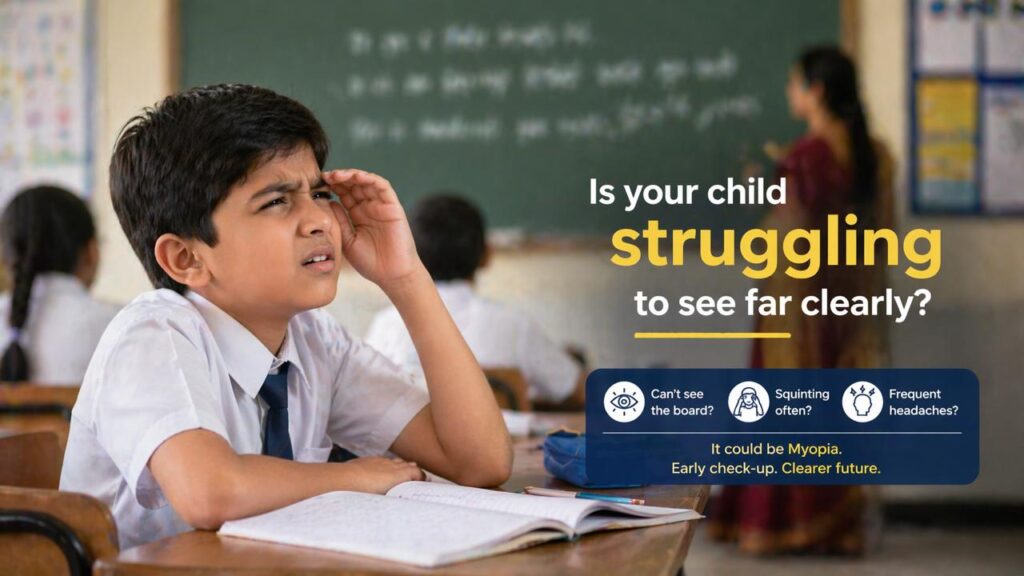
Is Your Child Struggling to See Far Away? Understanding Myopia in Children
If your child sits too close to the TV, squeezes their eyes to see the school board, or says distant objects look blurry, it may not be a habit — it could be myopia.
Myopia, also called short-sightedness, is becoming increasingly common in children worldwide. The good news is that it can be detected early and managed well when parents know what to look for.
What Exactly Is Myopia?
Myopia is a condition where near objects look clear, but distant objects appear blurry.
This usually happens when:
- The eyeball grows longer than normal, or
- The cornea bends light too strongly
As a result, light focuses in front of the retina instead of directly on it.
That is why children with myopia can read a book clearly, but may struggle to see the board in class.
How Is Myopia Different from Hypermetropia?
Myopia and hypermetropia are opposite focusing problems.
Myopia (Short-Sightedness)
- Near vision is clear
- Distance vision is blurry
Hypermetropia (Long-Sightedness)
- Distance vision may be clearer
- Near tasks like reading can be difficult
- Can cause headaches or eye strain in children
Both conditions need proper eye testing, but the treatment approach may differ.
Why Is Myopia Increasing in Children?
Across the world, more children are needing glasses than ever before.
Experts believe the main reasons include:
- Increased screen time
- Long hours of reading or close-up work
- Less outdoor play
- Reduced natural sunlight exposure
- Family history of glasses
Children today often spend more time indoors than previous generations, and that change matters.
A Common Story Parents Hear Too Late
Many parents say:
“We thought he was avoiding studies.”
But after an eye check-up, they realize the child simply could not see the board clearly.
Because myopia develops gradually, children may not complain. They assume everyone sees the same way they do.
Signs and Symptoms of Myopia
- Watch for these common signs:
- Squeezing eyes to see far objects
- Sitting close to TV or mobile screens
- Complaints of blurred distance vision
- Difficulty seeing the school board
- Frequent headaches
- Eye rubbing
- Reduced interest in studies or sports
What Should You Do?
1. Get an Eye Check-Up
A simple vision test can detect myopia early.
2. Encourage Outdoor Time
Daily outdoor play has been shown to help reduce the progression of myopia.
3. Manage Screen Habits
Take regular breaks and avoid continuous close-up screen use.
4. Follow the Right Treatment
Depending on the child, treatment may include:
- Glasses
- Special myopia control lenses
- Eye drops in selected cases
- Lifestyle changes
Can Myopia Get Worse?
Yes, untreated or progressive myopia can increase over time. Higher myopia may increase the risk of future eye problems later in life.
That is why early detection matters.
Myopia is common, but ignoring it can affect your child’s learning, confidence, and daily life.
If your child is struggling to see far away, losing focus in class, or constantly moving closer to screens, don’t assume it is just behavior.
It may simply be a vision problem that needs attention.
At Jeevansparsh Eye Hospital, we help children detect and manage myopia early — so they can see clearly, learn confidently, and grow better.